

Artificial intelligence can beat world champions at chess and Go, yet no model can tell you with confidence who will win on Saturday. That is not because football models are badly built. It is because football itself puts a hard ceiling on how predictable a match can be. Understanding that ceiling is the best defence against anyone selling "guaranteed" predictions.
Football is a low-scoring game
Most football matches are decided by one or two goals, and goals are rare events: a team may create dozens of attacks and convert two. When the final score depends on a handful of moments, small things matter a lot: a deflection, a post, a goalkeeper's fingertips.
Compare that with basketball, where a team scores dozens of times per game. Over so many possessions, luck tends to even out and the better team wins more reliably. In football, one lucky goal can decide a match on its own.
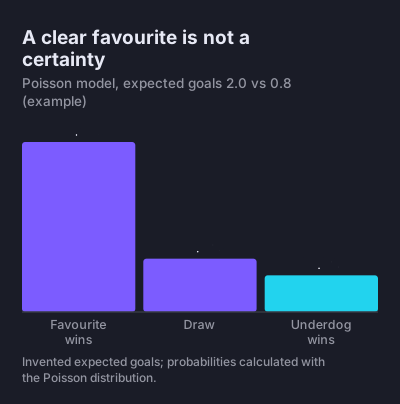
Example: Invented numbers to show the effect. Suppose a strong team creates chances worth 2.0 expected goals and its opponent 0.8. A simple Poisson model, which treats goals as random events at those average rates, still gives the weaker team roughly a one-in-seven chance of winning and the match about a one-in-five chance of ending in a draw. Better play makes a win likely, never certain.
How much of a goal is luck?
A team led by Fabian Wunderlich and Daniel Memmert at the German Sport University Cologne tried to measure this. They studied 7,263 goals scored in the English Premier League from 2012/13 to 2018/19 and checked each one for signs of chance: rebounds, deflections, long-range shots and defensive errors such as own goals.
They found that 46% of the goals had some random influence. The share fell from about 50% to 44% over the seven seasons, which the authors suggested could be linked to more professional, data-driven preparation. Even so, close to half of all goals involved a slice of luck.
What the best models can do
A good football model does not try to say who will win. It estimates the probability of each outcome, for example 55% home win, 25% draw and 20% away win. Even very strong favourites rarely get much above 80%, because a draw is always possible in football.
That changes what "right" means:
- A model that gives a team 70% and sees it lose is not necessarily wrong. Things given a 70% chance should fail about three times in ten.
- A model is judged over hundreds of matches, by asking whether its 70% predictions come true about 70% of the time. This is called calibration, and scoring rules such as the Brier score measure it.
Key point: The useful question is never "did the model get this match right?" but "over many matches, were its probabilities honest?"
The data a model never sees
Even a perfectly calibrated model works with incomplete information:
- Late team news. A key player falls ill on the morning of the match.
- Motivation. A team already safe in mid-table may rest players before a cup final.
- Tactics. A new coach changes the system and the old data describes a different team.
- Small samples. Early in a season, or after many transfers, there is little relevant data.
- Rare events. Red cards and penalties change matches and are very hard to forecast.
The market already knows a lot
Even when a model is good, the betting market is a tough competitor. Odds combine the bookmakers' models with information from the money that flows through them. Research suggests that consistently doing better than that consensus is very hard, as explained in Can AI Beat the Bookmakers?.
How to spot unrealistic claims
Watch out: Treat as a red flag any service that claims a very high "accuracy" without saying what was predicted, over how many matches and against what benchmark. Picking the favourite in every match already achieves a respectable-sounding hit rate, and adds nothing.
Ask three questions of any AI prediction:
- Does it give probabilities, or just "picks"?
- Has it been tested on matches it had not seen, over a large sample?
- Is its record compared with a simple benchmark, such as the betting market?
For a closer look at how a model builds its probabilities in the first place, read How AI Predicts Football Matches, or experiment with ratings in the Elo rating calculator.
- Football's low scoring makes single matches hard to predict, however good the model.
- A large study of Premier League goals found that 46% had some random influence.
- Good models give honest probabilities and are judged over many matches, not one.
Further reading
- Quantifying the role of chance in professional football — German Sport University Cologne, 2021
- Poisson distribution — Wikipedia: the model behind many goal forecasts
- Brier score — Wikipedia: how probability forecasts are scored

The AI Sports team writes about data, models and technology in sport.