
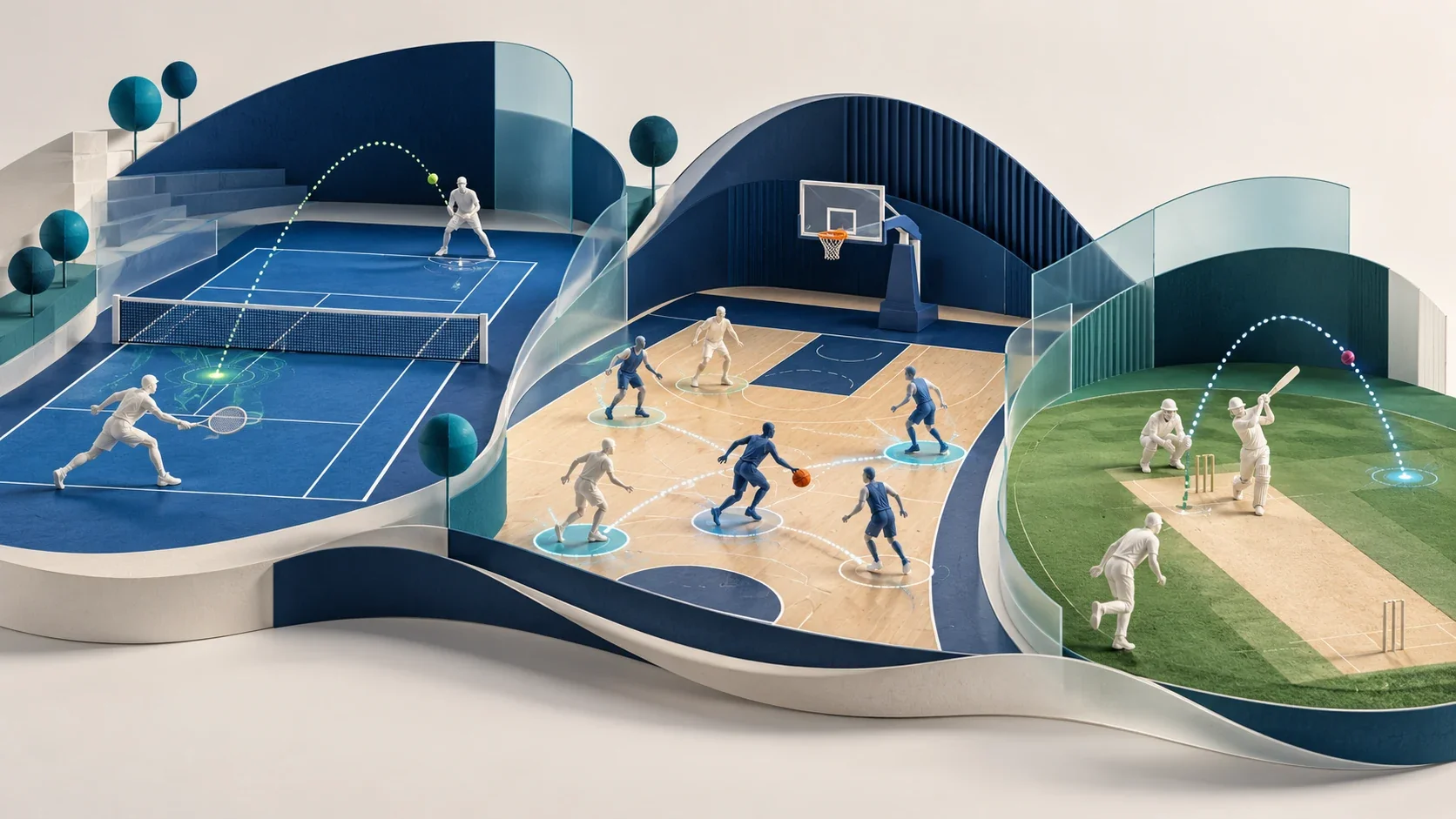
Football gets most of the attention when people argue about technology in sport, but it was not the first to adopt it. Tennis, basketball and cricket have used camera tracking for years, each in its own way. Comparing them shows how much depends on the shape of the sport itself: how often the ball is in play, how decisions are made and how much the result hangs on a single call.
At a glance
| Tennis | Basketball | Cricket | |
|---|---|---|---|
| Main use | Calling the ball in or out | Player and ball tracking for statistics | Reviewing umpires' decisions |
| Key technology | Multi-camera ball tracking | Optical player tracking | Ball tracking, sound and heat sensors |
| Human role | Chair umpire runs the match | Referees officiate; data is for analysis | Players request reviews; the third umpire decides |
| Milestone | Wimbledon uses no human line judges from 2025 | Tracking in every NBA arena from 2013–14 | DRS officially launched in Test cricket in 2009 |
Tennis: from challenges to fully electronic lines
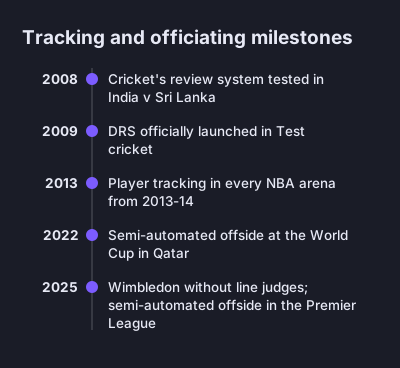
Tennis has used camera-based ball tracking for years, first as a review system that players could call on to challenge a line judge. In October 2024 the All England Club announced that from 2025 live electronic line calling would make all "out" and "fault" calls at Wimbledon, on all 18 match courts, after testing during the 2024 Championships. It meant no human line judges for the first time in the tournament's 147-year history.
Tennis suits this kind of automation: the question is almost always the same (did the ball land inside the line?), the court is small and fixed, and the answer is a matter of geometry.
Basketball: tracking every movement
Basketball took a different route. In 2013 the NBA and the data company STATS announced that SportVU player tracking would be installed in every NBA arena from the 2013–14 season. The system used six cameras to follow every player and the ball, producing statistics on speed, distance, player separation and possession.
The main purpose was not officiating but analysis: teams, broadcasters and the league gained data on movements that traditional box scores never recorded, such as how far a player runs or how close the nearest defender is when a shot is taken.
Cricket: reviewing the umpire
Cricket's Decision Review System (DRS) was tested in an India–Sri Lanka series in 2008 and officially launched by the ICC in November 2009, in a Test between New Zealand and Pakistan in Dunedin. It combines several tools:
- Ball tracking, which predicts the path the ball would have taken after hitting the batter's pad;
- Sound detection, which listens for the faint noise of ball touching bat;
- Infra-red imaging, which shows where the ball made contact.
DRS also includes a concept football has never formally adopted: umpire's call. When the tracking shows the ball only marginally hitting the stumps, the original on-field decision stands. It openly accepts that predicted paths have a margin of error.
Key point: Cricket's "umpire's call" is an honest admission that a prediction is not a measurement. Tracking where a ball went is precise; predicting where it would have gone carries uncertainty.
What football has taken from these sports
Football has borrowed from all three:
- Goal-line technology works like tennis line calling: a yes-or-no question about whether the whole ball crossed a line.
- Semi-automated offside relies on multi-camera tracking of players' limbs, much like the tracking systems of basketball.
- VAR resembles cricket's reviews, with one big difference: in football the referee, not the players, decides when something is reviewed.
We explain how the offside system works in Computer Vision in Football, and where officiating technology may go next in AI Referees: Where VAR Technology Is Heading.
Why football is harder
Football's decisions are often about interpretation rather than geometry. Was it a foul? Was the handball deliberate, or did the arm make the body "unnaturally bigger"? Cameras can measure where a hand was; they cannot yet decide whether it was a reasonable position for a player in motion. That is why football has automated the measurable parts, the line and the offside position, and kept people in charge of the rest.
- Tennis automated line calls fully at Wimbledon from 2025; the question is pure geometry.
- Basketball used tracking mainly for analysis, with cameras in every NBA arena from 2013–14.
- Cricket's DRS reviews umpires' decisions and keeps the umpire's call when tracking is marginal.
Further reading
- Wimbledon to replace line judges with technology from 2025 — ESPN, October 2024
- NBA expands partnership with STATS LLC to unveil player tracking technology for all 30 NBA teams — NBA, 2013
- Decision Review System — Wikipedia

The AI Sports team writes about data, models and technology in sport.