
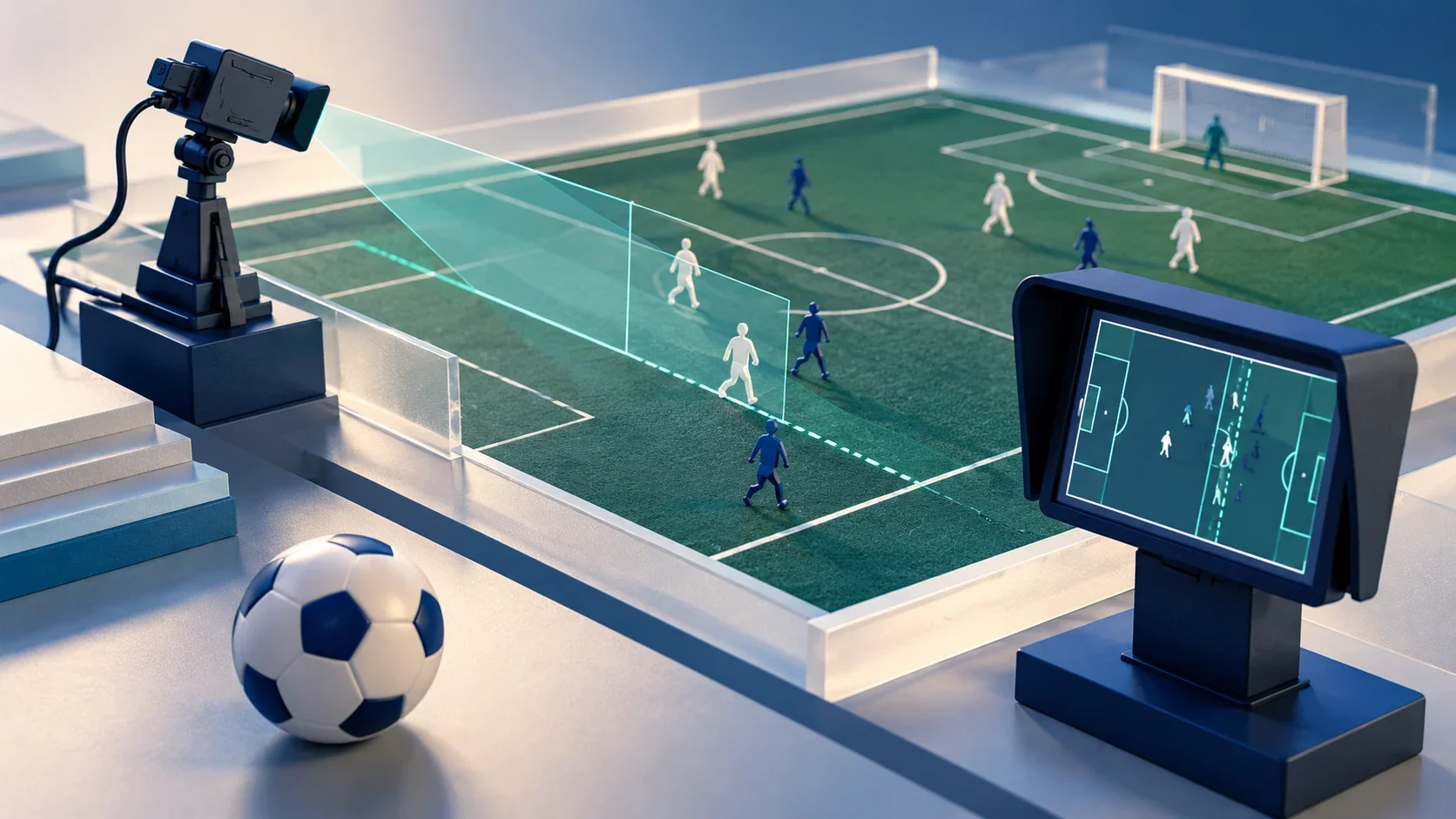
"Why not let a computer referee the match?" The question comes up after every controversial decision. The honest answer is that football has been handing parts of the job to machines for more than a decade, carefully and one decision at a time. Here is what is already automated, what has been added recently, and why the referee is not about to be replaced.
Step by step: what has been automated
| Technology | What it decides | How it works |
|---|---|---|
| Goal-line technology | Whether the whole ball crossed the goal line | Cameras track the ball and send a signal to the referee's watch within a second |
| VAR | Reviews of clear and obvious errors in key situations | Officials watch replays and advise the referee |
| Semi-automated offside | The offside line and the moment the ball was played | Tracking cameras follow players' limbs and the ball |
| Referee body cameras | Nothing: they show the referee's view | A camera on the referee records what they see |
The pattern is clear: machines take over questions with a measurable answer, and people keep the questions that need judgement.
Semi-automated offside spreads
FIFA first used semi-automated offside technology at the 2022 World Cup. Cameras under the stadium roof tracked up to 29 points on each player's body, and a sensor in the ball detected the exact moment it was kicked. The system proposed a decision; video officials checked it before telling the referee. We describe the system in detail in Computer Vision in Football.
Domestic leagues have since followed. The Premier League introduced its own semi-automated offside system on 12 April 2025, after testing it without live use and running it live in the FA Cup. It was developed with the referees' body PGMOL and the technology company Genius Sports and uses optical player tracking to place the offside line more quickly and produce graphics for the stadium and broadcasters.
Referee cameras
At the 2025 FIFA Club World Cup, referees wore body cameras after approval from the International Football Association Board (IFAB), the body that writes the Laws of the Game. The footage was shown in live broadcasts to give viewers the referee's point of view, and was used for referee training. FIFA said the camera would not be used to replay controversial incidents.
Key point: Body cameras do not make decisions. Their value is transparency and training: seeing what the referee could actually see is often the fairest way to judge a call.
Why a robot referee is far away
Many of football's hardest decisions are about interpretation:
- Fouls. Was the contact careless, reckless or using excessive force? The Laws describe these in words, not measurements.
- Handball. Did the arm make the body "unnaturally bigger"? That depends on the movement and the situation.
- Advantage. Should play go on because the fouled team is better off? That needs a sense of the game.
- Game management. Referees calm tempers, talk to captains and choose when to show a card. None of that is a computer vision problem.
A model could be trained on thousands of past decisions, but it would learn the inconsistencies of the referees who made them. And a decision that cannot be explained is hard for players and fans to accept, even if it is statistically sound.
Watch out: Automation also brings new problems: delays while decisions are checked, the risk of the technology failing during a match, and fans' frustration when the replay seems clear to them but the system says otherwise. Every new tool has to prove it removes more controversy than it creates.
What may come next
Based on where the technology already is, the most likely developments are:
- Faster offside decisions, as tracking becomes standard in more leagues.
- More transparency, with decisions explained to fans in the stadium, using graphics and the referee's own view.
- Better training data, as body-camera and tracking footage helps referees learn from their own matches.
- Help, not replacement, for judgement calls: tools that show officials the best angle quickly, rather than tools that decide for them.
- Football automates measurable decisions (goal line, offside) and leaves judgement calls to people.
- The Premier League adopted semi-automated offside on 12 April 2025; referee body cameras appeared at the 2025 Club World Cup.
- Fouls, handball and advantage depend on interpretation, which is why a fully robotic referee is not close.
Further reading
- Semi-automated offside technology to be introduced in Matchweek 32 — Premier League, 2025
- FIFA Club World Cup: referees to wear body cameras — CBS Sports, June 2025
- Semi-automated offside technology to be used at FIFA World Cup 2022 — FIFA, 1 July 2022

The AI Sports team writes about data, models and technology in sport.