

Injuries cost football clubs points and money: a key player missing for six weeks can change a season. Professional teams already measure almost everything players do in training, so the natural question is whether that data can warn staff before a player breaks down. Machine learning is one of the tools being tried. This case study looks at how it works, what a published study actually achieved, and where the limits are.
What clubs measure
Most professional players train wearing a small GPS unit, usually in a vest between the shoulder blades. It records, many times per second, where the player is and how fast they are moving. From that come the workload numbers sports scientists watch:
| Measure | What it describes |
|---|---|
| Total distance | How much a player covered in a session |
| High-speed running | Distance above a set speed threshold |
| Accelerations and decelerations | How often a player speeds up or brakes hard |
| Metabolic power | An estimate of the energy cost of the movement |
Staff combine these with information from medical checks, sleep and wellness questionnaires, match minutes and the player's injury history.
The traditional rule of thumb
Before machine learning, the best-known approach was the acute:chronic workload ratio (ACWR): the workload of the last week divided by the average weekly workload of the last few weeks. The idea is intuitive: a sudden spike compared with what the body is used to may raise the risk of injury. It is simple and widely used, but it squeezes a lot of information into one number.
A case study: the Italian club
In 2018 a team of researchers led by Alessio Rossi and Luca Pappalardo published one of the most cited studies on the subject in PLOS ONE. They followed 26 players of an Italian professional club during the 2013/14 season, recording GPS data from 931 individual training sessions between January and May 2014. In that period the players suffered 23 non-contact injuries.
The researchers built features from the training data, such as recent workloads and how they changed from week to week, and trained several models to predict whether a player would be injured in the next session. The best was a decision tree, a model that makes predictions through a series of simple yes-or-no questions.
The headline results:
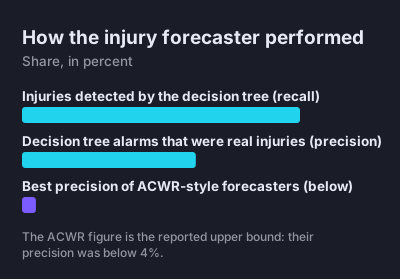
- the decision tree detected about 80% of the injuries (recall 0.80);
- when it raised an alarm, the player really did get injured in about half the cases (precision 0.50);
- forecasters based on ACWR-type ratios reached a precision below 4% on the same data.
In a more realistic test, where the model was retrained each week using only the data available up to then, it caught 9 of the 14 injuries from the sixth week to the end of the season, with a precision of 0.56.
Key point: The decision tree was chosen partly because people can read it. A rule such as "recent high-speed distance well above the player's normal level" is something a coach can discuss and act on, which matters more in a dressing room than a slightly better black box.
How to read those numbers
The results are impressive, but they come with important limits that the study itself acknowledges:
- One club, one half-season. 26 players and 23 injuries is a small sample. A model that works for one squad, one coach and one training method may not transfer to another.
- Non-contact injuries only. A tackle that breaks an ankle cannot be predicted from workload, and was outside the study.
- A precision of 0.5 still means false alarms. Half the warnings concern players who would have been fine. Resting them has a cost too.
- The model changes what it measures. If staff act on the warnings and reduce a player's load, the injury the model predicted may never happen, which makes the model hard to evaluate once it is in use.
Watch out: Be sceptical of any product claiming to "predict injuries" with a single accuracy figure. Injuries are rare, so a model that always says "no injury" can be more than 95% accurate and completely useless. Recall and precision on the injury cases are the numbers that matter.
What AI is actually used for
In practice, injury models are decision-support tools rather than oracles. They are used to:
- Flag players whose recent load is unusual compared with their own history.
- Prioritise which players the medical staff check first.
- Plan training weeks, especially in congested periods with two matches a week.
- Manage returns from injury, comparing the player's loads with their pre-injury levels.
The final call stays with physios, doctors and coaches, who know things no GPS unit records.
For the bigger picture of how sports data becomes a model, read Computer Vision in Football, which explains how tracking data is captured during matches.
- Clubs combine GPS workload data with medical and wellness information to look for injury risk.
- In one published study, a decision tree caught about 80% of non-contact injuries with 50% precision, far better than a simple workload ratio.
- The sample was small, false alarms are common, and the model supports staff rather than replacing them.
Further reading
- Effective injury forecasting in soccer with GPS training data and machine learning — Rossi, Pappalardo, Cintia, Iaia, Fernàndez and Medina, PLOS ONE, 2018
- Precision and recall — Wikipedia: the two measures used to judge the forecaster

The AI Sports team writes about data, models and technology in sport.